In the 20th century, members of both sides of my family -- the Packards (Massachusetts, New Hampshire, Vermont, Canada, Illinois, California) and the Reeds (Ohio and Indiana) -- have ended up in Florida.
My mother, born in Detroit, ended up in Florida as a child in 1920, and was raised here. Her adoptive father was a railroad freight agent in Pensacola. My father came to Florida after graduating from the Naval Academy and service on aircraft carriers, for flight training in 1937. He was born in California.
They married here, and their oldest child, my sister, was born here in 1938. My brother was born here in 1942, when my father came back to Florida, stationed in Miami.
We spent time here as a family in the early 1950s, as my father took various engineering jobs in Jacksonville and in Pensacola. Then we went back to California, as my father's family was there.
Finally, my mother brought my sister, my brother, and me back to Florida after Dad died, to be with her adoptive mom and sister for help with raising us. That was in 1954. Mom's biological sister and brother also lived in Florida. Later, a Packard aunt and uncle also relocated to Florida.
Though I was born in California, I have lived most of my life here, and now I consider myself "Floridated."
Within Florida, my husband and I have taken our family from Jacksonville, where he was born and raised, and where our older daughter was born, to St. Petersburg, where our younger daughter was born while my husband was stationed there in the Coast Guard.
After he was released from active duty, we returned to Jacksonville. We lived there several years, then made a short migration to the county just south-southwest of Jacksonville, where we live now.
During our time in our present home, we have separately spent time outside of Florida. My husband took a special assignment in the Coast Guard that had him living in New Orleans for a year, then he spent almost another year in Washington, D.C., in connection with that same special assignment. I spent a month in Seville, Spain and almost two years back in St. Petersburg, earning a master's degree at the University of South Florida St. Petersburg.
Our older daughter married a man who was also born in Jacksonville, and their son was also born there. After all our peregrinations, we've become a Florida family.
Showing posts with label Florida. Show all posts
Showing posts with label Florida. Show all posts
Wednesday, April 15, 2020

Sunday, April 8, 2012
Adventures in Indexing: Unusual Names
Today in my indexing adventure, the thing that stood out most was unusual names.
As I was indexing rural Florida, and I live in rural Florida, I was not terribly surprised at the names, but all the same they are unusual, especially for city folk, more especially for those not living in the rural south.
Unusual women's names outstripped unusual men's names.
Here are today's unusual women's names: Charles (yup, that's what it said); Nondas; Milbra (though I wonder if that were a mishearing of "Melba")' Ovella; Avie; Selzma; Trellie; Delamier.
Unusual men's names: Grose (can you imagine the teasing of a boy had that name today?); Dorthan; Verda.
I checked my stats, and so far the arbitrators are 98% in agreement with me. My paleography training is showing.
As I was indexing rural Florida, and I live in rural Florida, I was not terribly surprised at the names, but all the same they are unusual, especially for city folk, more especially for those not living in the rural south.
Unusual women's names outstripped unusual men's names.
Here are today's unusual women's names: Charles (yup, that's what it said); Nondas; Milbra (though I wonder if that were a mishearing of "Melba")' Ovella; Avie; Selzma; Trellie; Delamier.
Unusual men's names: Grose (can you imagine the teasing of a boy had that name today?); Dorthan; Verda.
I checked my stats, and so far the arbitrators are 98% in agreement with me. My paleography training is showing.
Saturday, August 6, 2011
All Hail John Gorrie!
Reading my blog feeds, I came across Karen Krugman's post at Genealogy Frame of Mind titled Heat and Ancestors (http://genealogyframeofmind.blogspot.com/2011/08/heat-ancestors.html -- see note at bottom). She's in Michigan talking about the heat. We here in Florida are particularly qualified to comment on heat, and Karen inspired me to do so.
Karen mentions the layers of clothing our ancestors wore, and I have seen photographs of how ladies in Florida dressed in the middle and late 19th century and early 20th century. If we were expected to dress that way nowadays, I would lead a rebellion that would make the Civil War look tame! I have often wondered how people survived the summer in Florida wearing so many clothes, and made out of heavy materials, not the light synthetics we have these days (though 100% cotton is still best for hot weather).
Karen also mentions her grandparents having a "wall unit here and there" for air conditioning, but not central air. In the 1950s, my widowed mother did not even have a window unit in the house, though my aunt and grandmother, who lived around the corner from us, did. We had an attic fan, an industrial fan installed in the ceiling in the hallway outside the bedrooms. It really did not do much to cool in the daytime when the temperature reached the 90s (F), but at least moving air was a benefit, especially if you were drinking ice water or iced tea. We drank a lot of that to keep cool. But at night, the attic fan did a great job of cooling. It required that we sleep with our windows open, because it operated by drawing air in through the windows and exhausting it out through the attic, but in those days there was little if any crime in our neighborhood. We thought nothing of leaving the windows open at night, or of leaving the house unlocked during the day.
In fact, my husband (whose family had window-unit air conditioning in their house in the '50s) and I did not have central air until after we were married. Our first house did not have it, nor the house we lived in while he was on active duty in St. Petersburg, FL. The house we built after we had come back to the Jacksonville area was the first to have a central air unit -- a heat pump, which is the most popular kind of air conditioning/heating in Florida. We have one in our present house, too, and in fact just had a new unit installed last year to replace the one which had kept going, like the Energizer Bunny, for 17 years.
Yes, we here in Florida have a soft spot in our hearts for the memory of Dr. John Gorrie, who developed the basic principle behind refrigeration and air conditioning. See more about this here at the website of the University of Florida. Gorrie is indeed "Our Hero," as the website characterizes him, as his work helps keep Florida cool. Thank you, John Gorrie!
(Note: I am sorry you have to cut and paste the link in the first paragraph; I tried for one solid hour to get a live link to work at that point in the paragraph, and Blogger stubbornly refused. I finally had to just give up.)
Karen mentions the layers of clothing our ancestors wore, and I have seen photographs of how ladies in Florida dressed in the middle and late 19th century and early 20th century. If we were expected to dress that way nowadays, I would lead a rebellion that would make the Civil War look tame! I have often wondered how people survived the summer in Florida wearing so many clothes, and made out of heavy materials, not the light synthetics we have these days (though 100% cotton is still best for hot weather).
Karen also mentions her grandparents having a "wall unit here and there" for air conditioning, but not central air. In the 1950s, my widowed mother did not even have a window unit in the house, though my aunt and grandmother, who lived around the corner from us, did. We had an attic fan, an industrial fan installed in the ceiling in the hallway outside the bedrooms. It really did not do much to cool in the daytime when the temperature reached the 90s (F), but at least moving air was a benefit, especially if you were drinking ice water or iced tea. We drank a lot of that to keep cool. But at night, the attic fan did a great job of cooling. It required that we sleep with our windows open, because it operated by drawing air in through the windows and exhausting it out through the attic, but in those days there was little if any crime in our neighborhood. We thought nothing of leaving the windows open at night, or of leaving the house unlocked during the day.
In fact, my husband (whose family had window-unit air conditioning in their house in the '50s) and I did not have central air until after we were married. Our first house did not have it, nor the house we lived in while he was on active duty in St. Petersburg, FL. The house we built after we had come back to the Jacksonville area was the first to have a central air unit -- a heat pump, which is the most popular kind of air conditioning/heating in Florida. We have one in our present house, too, and in fact just had a new unit installed last year to replace the one which had kept going, like the Energizer Bunny, for 17 years.
Yes, we here in Florida have a soft spot in our hearts for the memory of Dr. John Gorrie, who developed the basic principle behind refrigeration and air conditioning. See more about this here at the website of the University of Florida. Gorrie is indeed "Our Hero," as the website characterizes him, as his work helps keep Florida cool. Thank you, John Gorrie!
(Note: I am sorry you have to cut and paste the link in the first paragraph; I tried for one solid hour to get a live link to work at that point in the paragraph, and Blogger stubbornly refused. I finally had to just give up.)
Tuesday, July 12, 2011
On the Trail of Samuel Rhoades/Rhodes
There is a family legend in my husband's family about his grandfather, Andrew Lewis Rhodes. The tale goes that sometime in the late 1880s or early 1890s, Andrew and his brother Harley were placed in an orphanage by their mother, Ida M. (Dewey) Rhoades/Rhodes. The variations in the spelling of the surname are "explained" in this story, which relates that Andrew was not a good speller as a little boy, and he wrote his name "Rhodes" rather than "Rhoades" upon entering the orphanage. Why the boys were placed in the institution -- located somewhere around Chillicothe, Ohio -- is not revealed in the tale.
The bit about the name spelling seems a bit specious, for a couple of reasons. It is unlikely the child would have signed himself into the orphanage; his mother would have done that. I have no idea what sort of speller Ida was. The second reason this portion of the tale, at least, seems bogus is that in Andrew Lewis Rhodes's Railroad Retirement file, he spells his father's name as "Rhoades" on one document, and "Rhodes" on another. If he was a poor speller as a child, he did not lose the habit as an adult! His own name, however, he consistently signed as "Rhodes."
 The photograph at right was found among Andrew Rhodes's effects. I found it in Andrew's wallet, which we had in a box of other items. On the back, Andrew identified the seated man as his father, Samuel. The man standing next to him, with his hand on Samuel's shoulder, is unidentified. To me, they appear a couple of rough-looking characters. I cannot determine what the light patch on the standing man's hat is, but I wonder if it was not a police badge or a Pinkerton badge. I have not been able to find out anything about the circumstances under which this photo was taken. Were they both cops or private security? Was the standing man a cop, and is that the hand of an arresting officer on Samuel's shoulder?
This could have a bearing on why the boys were placed in the orphanage. Ida Dewey Rhoades/Rhodes was apparently alone at that time, with no means of support, and put the boys in the orphanage so they could be cared for. She subsequently remarried, and Harley, at age 15, is with Ida and her second husband and their own three children, in the 1900 census. Andrew, who would have been 18 in 1900, has so far not been located in that census,
Andrew, in his Railroad Retirement file, lists his birthplace as Pike County, Ohio. In an earlier census, 1870, there is a Samuel Rhoades in the home of his father Levi Rhoades, and not far from this household is a Dewey family with a daughter, Ida M. My thought is that this is probably Andrew's parents as youngsters. I need to corroborate that, but have not yet found, for instance, a birth record for Andrew. It is the right county, however. I also am on the track o a marriage certificate for a Samuel H. Rhoades and Ida Mary [sic] Dewey, recorded in the Pike County records as microfilmed by the LDS church. The film is waiting for me at the Jacksonville Public Library, but I have not yet, due to illness, got a chance to view it. Again, it is the right county, and the right time frame.
Harley Rhoades died in Florida in 1947. I have found him and his wife in a couple of city directories, as well as seeing his death listed in the Florida death index. Andrew came to Florida as well, and married in Lakeland. Later, he came to Jacksonville in the course of his work as a Pullman conductor, and died there in 1966.
Though the trail is obscure, I feel that I am on the track of Samuel H. Rhoades/Rhodes, and will lay him to heel one of these days -- perhaps as the standing man in the photo did so long ago. That is a story I really want to uncover!
.
The bit about the name spelling seems a bit specious, for a couple of reasons. It is unlikely the child would have signed himself into the orphanage; his mother would have done that. I have no idea what sort of speller Ida was. The second reason this portion of the tale, at least, seems bogus is that in Andrew Lewis Rhodes's Railroad Retirement file, he spells his father's name as "Rhoades" on one document, and "Rhodes" on another. If he was a poor speller as a child, he did not lose the habit as an adult! His own name, however, he consistently signed as "Rhodes."

This could have a bearing on why the boys were placed in the orphanage. Ida Dewey Rhoades/Rhodes was apparently alone at that time, with no means of support, and put the boys in the orphanage so they could be cared for. She subsequently remarried, and Harley, at age 15, is with Ida and her second husband and their own three children, in the 1900 census. Andrew, who would have been 18 in 1900, has so far not been located in that census,
Andrew, in his Railroad Retirement file, lists his birthplace as Pike County, Ohio. In an earlier census, 1870, there is a Samuel Rhoades in the home of his father Levi Rhoades, and not far from this household is a Dewey family with a daughter, Ida M. My thought is that this is probably Andrew's parents as youngsters. I need to corroborate that, but have not yet found, for instance, a birth record for Andrew. It is the right county, however. I also am on the track o a marriage certificate for a Samuel H. Rhoades and Ida Mary [sic] Dewey, recorded in the Pike County records as microfilmed by the LDS church. The film is waiting for me at the Jacksonville Public Library, but I have not yet, due to illness, got a chance to view it. Again, it is the right county, and the right time frame.
Harley Rhoades died in Florida in 1947. I have found him and his wife in a couple of city directories, as well as seeing his death listed in the Florida death index. Andrew came to Florida as well, and married in Lakeland. Later, he came to Jacksonville in the course of his work as a Pullman conductor, and died there in 1966.
Though the trail is obscure, I feel that I am on the track of Samuel H. Rhoades/Rhodes, and will lay him to heel one of these days -- perhaps as the standing man in the photo did so long ago. That is a story I really want to uncover!
.
Thursday, May 13, 2010
The Value of a UPS
Sorry, United Parcel Service, I'm not talking about you today, though I have had good service from you over the years. I'm talking about that OTHER UPS -- the uninterrupted power source, a peripheral for your computer which is essentially a battery backup. It comes on immediately when it senses that the elecrtic power is going off, and gives you time, if not to keep working, then to save your work quickly and shut down.
I live in a rural area in northeast Florida served by an electric cooperative. We get good service, on the whole, from Clay Electruc Co-op, but occasionally, and for some reason more often during the summer, we are subject to very short blackouts. The electricity will pop off suddenly and unexpectedly, and then quickly come back on.
It is brief, but it is enough to trip a computer off. And just a few minutes ago, I had just finished a particularly difficult transcription from a probate file for a resident of St. Augustine who died in about 1809, which constituted a half hour or more of work for one page. I was just finishing adding the source citation and was just about to save the file, and the electricity tripped off. It rapidly came back on, but it was enough that my work was gone.
Not only do we have these little blackouts, we are in Florida, the lightning capital of the world, where we also have frequent afternoon thunderstorms in the summer.
For one thing, I suppose I should save every 10 minutes or so. For another, I asked my husband to buy me a UPS. He sees the value in it, for he has one for himself. I just hadn't asked for my own before, but just a few minutes ago, my need for one was made quite clear!
All of us who use computers in our genealogical investigations and who live in areas where the electricity is subject to frequent interruption should have a UPS.
I live in a rural area in northeast Florida served by an electric cooperative. We get good service, on the whole, from Clay Electruc Co-op, but occasionally, and for some reason more often during the summer, we are subject to very short blackouts. The electricity will pop off suddenly and unexpectedly, and then quickly come back on.
It is brief, but it is enough to trip a computer off. And just a few minutes ago, I had just finished a particularly difficult transcription from a probate file for a resident of St. Augustine who died in about 1809, which constituted a half hour or more of work for one page. I was just finishing adding the source citation and was just about to save the file, and the electricity tripped off. It rapidly came back on, but it was enough that my work was gone.
Not only do we have these little blackouts, we are in Florida, the lightning capital of the world, where we also have frequent afternoon thunderstorms in the summer.
For one thing, I suppose I should save every 10 minutes or so. For another, I asked my husband to buy me a UPS. He sees the value in it, for he has one for himself. I just hadn't asked for my own before, but just a few minutes ago, my need for one was made quite clear!
All of us who use computers in our genealogical investigations and who live in areas where the electricity is subject to frequent interruption should have a UPS.
Sunday, February 7, 2010
Asking the Right Questions
In our genealogical study and training ,we are urged to question our sources. Who created the source? When was it created? Why was it created? These are important questions, and I can give you an example as to why they are important.
In my research for my current grant project on the family structure of St. Augustine, Spanish Florida, 1783-1821, I came across an excellent article by Sherry Johnson, titled "The Spanish St. Augustine Community 1784-1795: A Reevaluation" (Florida Historical Quarterly, 68:1 27-54, July 1989). In the article, Johnson discusses the ethnic/national makeup of the population of St. Augustine, and deals with a contention entrenched in the historiography of St. Augustine: that the Spanish population during that period was quite fluid and therefore not of much consequence in the affairs of the town. From a comparison of the census of 1786 with a town plan drawn up in 1788 (which includes owners' names for town plots) and the census of 1793, it appears the English and Menorcan components of the population were more stable, and therefore of more consequence in the town's history.
This evaluation stems from the work of Joseph Byrne Lockey, who transcribed and translated the censuses found on Reel 148 of the East Florida Papers, Bundle 323A. The East Florida Papers, the originals of which are at the Library of Congress, consist in Spanish records seized at the time of the United States' takeover of Florida in 1821. There are several censuses from 1783 to 1814 on Reel 148 of the microfilmed East Florida Papers, but not all of them bear dates. It has been difficult to discern which enumerations apply to which years. Lockey transcribed the entirety, and thought along with everyone else at the time -- the early to mid 1940s -- that there was one huge census from 1793, the census of 1786 which is dated and identified, and a few from about 1813-1814. However, when Lockey was working with this long transcription of the supposed 1793 census, he discovered that names appeared more than once, with changes in family composition and in ages of the individuals. He was able to figure out that there was more than one census recorded, and to figure out the years of each of them within a small margin of error.
However, in examining these censuses, according to Johnson, Lockey also reached the above conclusion -- that the Spanish population turned over fairly rapidly. He assumed that these were the government officials who served short terms and then returned to Spain or Cuba or wherever. This rapid turnover, as perceived by Lockey, led to the conclusion that the Spanish were not that tied to St. Augustine during the period, and were not that important.
The problem is that in looking at the 1786 census, Lockey, a historian, did not ask an important genealogical question (which, may I point out, is also an important historical question): Who created the 1786 census? WHY was the 1786 census created?
Johnson did more research, thinking like a genealogist, and came up with the explanation, and support for the idea that St. Augustine in the Second Spanish Period was very much a Spanish town with a very stable and significant Spanish or Spanish-descended population. It is well-known that the census was taken by the parish curate, Father Thomas Hassett (he was Irish). The census has a brief descriptive introduction signed by Father Hassett, in which he states that he did not enumerate the Spanish officials or the troops of the garrison of the Castillo de San Marcos. He took the census because he wanted to know how many protestant foreigners resided in St. Augustine, for whom and whose children he wanted to create a school to catechize these protestants in the Catholic faith.
For 20 years, between 1763 and 1783, St. Augustine had been under the control of England. When the Spanish returned, there was a decree that foreigners who wished to remain as residents of the town must swear allegiance to the King of Spain and must, if not already Catholic, convert to the faith. It was those protestants who had been permitted to remain whom Father Hassett wanted to enroll in his school. It follows, then, that Father Hassett would not have enumerated the Spanish and Spanish-descendant families in St. Augustine who were already Catholic and not in need of Father Hassett's schooling.
Johnson adduces much other evidence to show the importance of the Spanish and Spanish-descended population of St. Augustine.
We need to remember to question our sources, for doing so may prevent us from reaching erroneous conclusions.
.
In my research for my current grant project on the family structure of St. Augustine, Spanish Florida, 1783-1821, I came across an excellent article by Sherry Johnson, titled "The Spanish St. Augustine Community 1784-1795: A Reevaluation" (Florida Historical Quarterly, 68:1 27-54, July 1989). In the article, Johnson discusses the ethnic/national makeup of the population of St. Augustine, and deals with a contention entrenched in the historiography of St. Augustine: that the Spanish population during that period was quite fluid and therefore not of much consequence in the affairs of the town. From a comparison of the census of 1786 with a town plan drawn up in 1788 (which includes owners' names for town plots) and the census of 1793, it appears the English and Menorcan components of the population were more stable, and therefore of more consequence in the town's history.
This evaluation stems from the work of Joseph Byrne Lockey, who transcribed and translated the censuses found on Reel 148 of the East Florida Papers, Bundle 323A. The East Florida Papers, the originals of which are at the Library of Congress, consist in Spanish records seized at the time of the United States' takeover of Florida in 1821. There are several censuses from 1783 to 1814 on Reel 148 of the microfilmed East Florida Papers, but not all of them bear dates. It has been difficult to discern which enumerations apply to which years. Lockey transcribed the entirety, and thought along with everyone else at the time -- the early to mid 1940s -- that there was one huge census from 1793, the census of 1786 which is dated and identified, and a few from about 1813-1814. However, when Lockey was working with this long transcription of the supposed 1793 census, he discovered that names appeared more than once, with changes in family composition and in ages of the individuals. He was able to figure out that there was more than one census recorded, and to figure out the years of each of them within a small margin of error.
However, in examining these censuses, according to Johnson, Lockey also reached the above conclusion -- that the Spanish population turned over fairly rapidly. He assumed that these were the government officials who served short terms and then returned to Spain or Cuba or wherever. This rapid turnover, as perceived by Lockey, led to the conclusion that the Spanish were not that tied to St. Augustine during the period, and were not that important.
The problem is that in looking at the 1786 census, Lockey, a historian, did not ask an important genealogical question (which, may I point out, is also an important historical question): Who created the 1786 census? WHY was the 1786 census created?
Johnson did more research, thinking like a genealogist, and came up with the explanation, and support for the idea that St. Augustine in the Second Spanish Period was very much a Spanish town with a very stable and significant Spanish or Spanish-descended population. It is well-known that the census was taken by the parish curate, Father Thomas Hassett (he was Irish). The census has a brief descriptive introduction signed by Father Hassett, in which he states that he did not enumerate the Spanish officials or the troops of the garrison of the Castillo de San Marcos. He took the census because he wanted to know how many protestant foreigners resided in St. Augustine, for whom and whose children he wanted to create a school to catechize these protestants in the Catholic faith.
For 20 years, between 1763 and 1783, St. Augustine had been under the control of England. When the Spanish returned, there was a decree that foreigners who wished to remain as residents of the town must swear allegiance to the King of Spain and must, if not already Catholic, convert to the faith. It was those protestants who had been permitted to remain whom Father Hassett wanted to enroll in his school. It follows, then, that Father Hassett would not have enumerated the Spanish and Spanish-descendant families in St. Augustine who were already Catholic and not in need of Father Hassett's schooling.
Johnson adduces much other evidence to show the importance of the Spanish and Spanish-descended population of St. Augustine.
We need to remember to question our sources, for doing so may prevent us from reaching erroneous conclusions.
.
Wednesday, January 13, 2010
What a kick!
In science-fiction fandom, there is a word: "egoboo." It comes from the phrase "ego boost," and I just got one.
As I've mentioned, my book, Non-Federal Censuses of Florida, 1784-1945: A Guide to Sources, has just been published. Now, it certainly is a kick to hold in your hand a book that has your name on it as the author.
What really gets you jazzed is looking it up in a library catalog and seeing the entry. I must confess that it is possible that not everyone would get excited about that, but I am an ex-librarian, and I guess that makes a book catalog entry special to me. I just looked my book up in the catalogs of the Clay County Public Library and the library of the University of North Florida. Nice! Apparently, the Jacksonville Public Library hasn't cataloged their copy yet. I donated copies to each of these libraries.
I have to admit to feeling self-conscious about tooting my own horn, but in this business, you have to do some shameless self-promotion from time to time.
I just hope the great feeling I got from seeing my book in the catalogs of libraries won't be deflated in the next few months as reviews come out.
I'll let you know.
.
As I've mentioned, my book, Non-Federal Censuses of Florida, 1784-1945: A Guide to Sources, has just been published. Now, it certainly is a kick to hold in your hand a book that has your name on it as the author.
What really gets you jazzed is looking it up in a library catalog and seeing the entry. I must confess that it is possible that not everyone would get excited about that, but I am an ex-librarian, and I guess that makes a book catalog entry special to me. I just looked my book up in the catalogs of the Clay County Public Library and the library of the University of North Florida. Nice! Apparently, the Jacksonville Public Library hasn't cataloged their copy yet. I donated copies to each of these libraries.
I have to admit to feeling self-conscious about tooting my own horn, but in this business, you have to do some shameless self-promotion from time to time.
I just hope the great feeling I got from seeing my book in the catalogs of libraries won't be deflated in the next few months as reviews come out.
I'll let you know.
.
Thursday, January 7, 2010
52 Weeks to Better Genealogy: The Local Public Library
Today, in the first installment of this year-long blogging theme, we were supposed to go to our local library and jot down titles of books which might be useful in our genealogical searching. I have four library cards, counting my University ID card. I'm going to choose not my nearest library, but the one with the largest genealogy collection. For one thing, I'm not from around here, though my husband is. He has Florida connections that I lack. So I'm more likely to find something useful in a larger collection. That collection is at the Jacksonville (FL) Public Library.
Some possibly useful items, be they sources or finding aids:
GEN 929.3768 T297b reel 1
Births 1908-1912, index [microform]
Florida births, which may be useful in locating birth information on my husband's father's family (mainly some of pa-in-law's uncles and aunts).
929.1 ELLIOTT 2009
Finding anyone, anywhere, anywhen by Noel Montgomery Elliott
Sounds like something any genealogist could use!
GEN 929.1025 E133e 1964
East Tennessee historical and genealogical directory by the East Tennessee Historical Society
Possibly useful in tracing my mother's mother's family, who hailed from East Tennessee. The family was there about 100 years before uprooting and going to Indiana.
GEN 929.509744 L222g 2009
A guide to Massachusetts cemeteries by David Allen Lambert
I have a lot of ancestors buried in Massachusetts!
GEN 929.1072 I72f
Finding your Canadian ancestors: a beginner's guide by Sherry Irvine and Dave Obee
Even those of us with some experience can find new information and methods from beginners' books, and I have Canadian ancestry.
GEN 929.1 D225g
The genealogist's guide to researching tax records by Carol Cooke Darrow and Susan Winchester
Tax records are an excellent resource; I can use new information on where to find them and how to use them.
AE 1.102:W 89/2 [government document]
Finding information on personal participation in World War II (National Archives and Records Administration)
My father was a Naval officer; my husband's father and mother were shipyard workers. Can we find out more about them?
929.374 RAPAPORT
New England court records: a research guide for genealogists and historians by Diane Rapaport
Another resource that would be good for info on my New England ancestors.
That is just a scratch-the-surface list, but I don't want to make a huge blog entry! Suffice it to say that browsing the library's collection can yield some impressive results.
.

Some possibly useful items, be they sources or finding aids:
GEN 929.3768 T297b reel 1
Births 1908-1912, index [microform]
Florida births, which may be useful in locating birth information on my husband's father's family (mainly some of pa-in-law's uncles and aunts).
929.1 ELLIOTT 2009
Finding anyone, anywhere, anywhen by Noel Montgomery Elliott
Sounds like something any genealogist could use!
GEN 929.1025 E133e 1964
East Tennessee historical and genealogical directory by the East Tennessee Historical Society
Possibly useful in tracing my mother's mother's family, who hailed from East Tennessee. The family was there about 100 years before uprooting and going to Indiana.
GEN 929.509744 L222g 2009
A guide to Massachusetts cemeteries by David Allen Lambert
I have a lot of ancestors buried in Massachusetts!
GEN 929.1072 I72f
Finding your Canadian ancestors: a beginner's guide by Sherry Irvine and Dave Obee
Even those of us with some experience can find new information and methods from beginners' books, and I have Canadian ancestry.
GEN 929.1 D225g
The genealogist's guide to researching tax records by Carol Cooke Darrow and Susan Winchester
Tax records are an excellent resource; I can use new information on where to find them and how to use them.
AE 1.102:W 89/2 [government document]
Finding information on personal participation in World War II (National Archives and Records Administration)
My father was a Naval officer; my husband's father and mother were shipyard workers. Can we find out more about them?
929.374 RAPAPORT
New England court records: a research guide for genealogists and historians by Diane Rapaport
Another resource that would be good for info on my New England ancestors.
That is just a scratch-the-surface list, but I don't want to make a huge blog entry! Suffice it to say that browsing the library's collection can yield some impressive results.
.
Sunday, January 3, 2010
Sentimental Sunday: Remembering Elizabeth Reed

My aunt, Elizabeth Reed, pictured second from left in the above photo, was a character. That is said in the best sense of the word -- an original, a standout, someone with a definite sense of humor.
Well, let's back up a bit. She wasn't biologically or genealogically my aunt, she was my second cousin. However, she was always my aunt to me, because my mother was an intra-family adoption. My mother, Martha Reed Packard, is at the right in this picture, in white. My grandmother -- that is, my grandaunt, Mary Reed is at left. My mother's father, Benjamin Franklin "Frank" Reed, was the brother of Mary Reed's husband, Perry Wilmer Reed. Frank Reed died in a railroad accident in 1917, before my mother's first birthday. The Reed family saw to it that little Martha was placed with Perry and Mary, and the adoption was final in 1920. Mary and Perry raised her as their own, and as far as we were all concerned, "Chollie" (Mary) and "Sissy" (Elizabeth) were grandmother and aunt to my siblings and me.
And Elizabeth Reed did help raise me, very actively. She saw to it, as my godmother, that I went to church. Got me in the choir, encouraged me to join the youth group, Episcopal Young Churchman, which I eventually served as a delegate to the diocesan House of Episcopal Young Churchmen and as treasurer. She was adamant that I go to college, and got in touch with our Congressman, Charles E. Bennett, to see to it that I got Veteran's Administration and Social Security assistance based on my father's service in the U.S. Navy during World War II. She encouraged me to apply to Florida State University, where I was accepted. She got me hooked up with the Southern Scholarship and Research Foundation in Tallahassee so that I was awarded a housing scholarship. She also taught me (and my sister and brother) how to drive.
"Sissy" did not live to see me graduate from Florida State University, nor did she get to see me receive such honors as being inducted into Phi Beta Kappa, or get into graduate school for a master's degree in library science. She died in October of 1967, but she went the way she would have wanted to go, with her boots on, attending the national conference of Planned Parenthood in New York. She was the director of the northeast Florida chapter of Planned Parenthood in Jacksonville. And she always did find it a wonder why, when people had questions about sex and parenthood, they always came to an unmarried middle-aged woman!
She had a series of monologues which she would perform for civic groups in Jacksonville and around Florida. She did this in connection with her talks on health and wellness, as Director of Health Information for the then State Board of Health (now the Department of Health and Rehabilitative Services) and later as director of the Planned Parenthood chapter. The monologues were funny and poignant, and not a one of them was committed to paper. They were all in her memory, and so were different each time she performed them. They ranged from a hilarious parody of a hospital bedside visitor to variations on the theme of "Twinkle, Twinkle, Little Star" (from a country singer to a child in a pageant to a torch singer), to a sober and wonderful tale of a grandmother who pioneered the American west talking to her upset teenage granddaughter.
She definitely was a character, and I have missed her much over the years. I named one of our daughters for her, and I do wish she could have met my daughters. They're characters, too.
.
Tuesday, November 10, 2009
SNGF -- REALLY late: Surname Distribution
I'm really late this week with Saturday Night Genealogy Fun, but it is getting toward the end of the term, and I have lots of reading to do (including the entirety of Boccacio's Decameron, which was considered terribly salacious in ages past, but is mild compared to what we see on television these days!) and papers to write and other stuff going on.
So here it is: This week, according to Randy Seaver of Genea-Musings, we are to look at the geographic distribution of one of our surnames.
1) Find out the geographical distribution of your surname - in the world, in your state or province, in your county or parish. I suggest that you use the Public Profiler site at http://www.publicprofiler.org/worldnames/, which seems to work quickly and easily. However, you cannot capture the image as a photo file - you have to capture the screen shot, save it and edit it.
2) Tell us about your surname distribution in a blog post of your own (with a screen shot if possible), in comments to this post, or in comments on a social networking site like Facebook and Twitter.
Searching on my paternal surname/maiden name of Packard at the website recommended by Randy in his instructions, reproduced above, I found that the worldwide distribution shows the surname mainly in Europe and North America, with a smattering in India, Australia, and a bit more densely in New Zealand. Europe shows the surname distributed thus:

What stuns me is that the name shows up in Spain and a tiny bit in Italy. What is even more surprising to me is that in Spain, the surname is present in Andalucia, which is where I was in the month of May a couple years ago, when I went to Seville to research at the General Archive of the Indies. If I'd known that, I would have grabbed the phone book and done some looking. It would have been big fun to have met my primos españoles (Spanish cousins).
Another stunning thing about the map is Great Britain, where my 8x great-grandfather was born. The concentration of the surname is shown as being very low in England except for the teal spot on the Channel coast. That is East Anglia, part of which is the county of Suffolk, where my ancestor Samuel Packard was born. He emigrated to Massachusetts in 1638, to join other separatists (which we call Puritans) who could no longer stand the Church of England. (And here's another irony -- I was raised in the Episcopal Church, a member of the Anglican -- that is, Church of England -- Communion.)
The next map has a lot to say about where the Packards are most heavily concentrated now:

On the world map, the most dense concentration of the Packard surname is in the United States. There are some also in Canada -- where my father's line spent three generations, in between being residents of Massachusetts and ending up in Illinois. In the U.S., we Packards are in every state except North Dakota. My own line went from Massachusetts to New Hampshire to Vermont, which was my 4x great-grandfather Richards Packard (yes, there is an "s" on his first name, which is from the maiden name of his mother, Mercy Richards) in an ever-northward quest for land after the American Revolution, in which he fought in two different Massachusetts regiments. This search for land ended him up in Canada. Not every American who went to Canada after the Revolution was a Tory -- many of them went because in Canada they were giving land away and they didn't much care who they were giving it to!
After a couple or three generations in Canada, my great-great grandfather and a fistful of his siblings came back to the U.S., some by way of Massachusetts, some (including my ggf) by way of New York (Chautauqua County), and some directly to end up all of them in Bloomington, Illinois. From there, my great-grandfather Oscar Packard, who was a real estate developer, went to California in the early 20th century, a great time to have been in real estate in California!
Me, I live in Florida, and here's where the surname occurs in the Sunshine State (which, with the remnants of Ida meandering around, is not experiencing much sunshine this week!)

There are some in the panhandle, and the rest distributed from northeast Florida, where I live, down the peninsula. See Jacksonville up in the upper right? See the county which is completely white -- completely devoid of the surname -- just below Jacksonville (which comprises nearly all of Duval County)? That blank county is Clay County, where I live. I don't count in this because my surname for the past 38 years has been Rhodes! By the way, the surname Rhodes is shown to be present in Clay County in moderate density -- including one reprobate listed just below us in the telephone book, who apparently did not pay his bills and for whom we were getting collection calls for a while. I had to resort to recommending that the caller employ a straight-edge when looking up numbers in the phone book!
I have to say I was unaware that there were any Packards in Bradford County, which is the little triangle just to the west of Clay County, but apparently there are. None of these Packards are close relations to me. But I suppose I should at least try to get in touch with them and see if any of them are interested in genealogy and share some ancestors with me.
.
So here it is: This week, according to Randy Seaver of Genea-Musings, we are to look at the geographic distribution of one of our surnames.
1) Find out the geographical distribution of your surname - in the world, in your state or province, in your county or parish. I suggest that you use the Public Profiler site at http://www.publicprofiler.org/worldnames/, which seems to work quickly and easily. However, you cannot capture the image as a photo file - you have to capture the screen shot, save it and edit it.
2) Tell us about your surname distribution in a blog post of your own (with a screen shot if possible), in comments to this post, or in comments on a social networking site like Facebook and Twitter.
Searching on my paternal surname/maiden name of Packard at the website recommended by Randy in his instructions, reproduced above, I found that the worldwide distribution shows the surname mainly in Europe and North America, with a smattering in India, Australia, and a bit more densely in New Zealand. Europe shows the surname distributed thus:

What stuns me is that the name shows up in Spain and a tiny bit in Italy. What is even more surprising to me is that in Spain, the surname is present in Andalucia, which is where I was in the month of May a couple years ago, when I went to Seville to research at the General Archive of the Indies. If I'd known that, I would have grabbed the phone book and done some looking. It would have been big fun to have met my primos españoles (Spanish cousins).
Another stunning thing about the map is Great Britain, where my 8x great-grandfather was born. The concentration of the surname is shown as being very low in England except for the teal spot on the Channel coast. That is East Anglia, part of which is the county of Suffolk, where my ancestor Samuel Packard was born. He emigrated to Massachusetts in 1638, to join other separatists (which we call Puritans) who could no longer stand the Church of England. (And here's another irony -- I was raised in the Episcopal Church, a member of the Anglican -- that is, Church of England -- Communion.)
The next map has a lot to say about where the Packards are most heavily concentrated now:

On the world map, the most dense concentration of the Packard surname is in the United States. There are some also in Canada -- where my father's line spent three generations, in between being residents of Massachusetts and ending up in Illinois. In the U.S., we Packards are in every state except North Dakota. My own line went from Massachusetts to New Hampshire to Vermont, which was my 4x great-grandfather Richards Packard (yes, there is an "s" on his first name, which is from the maiden name of his mother, Mercy Richards) in an ever-northward quest for land after the American Revolution, in which he fought in two different Massachusetts regiments. This search for land ended him up in Canada. Not every American who went to Canada after the Revolution was a Tory -- many of them went because in Canada they were giving land away and they didn't much care who they were giving it to!
After a couple or three generations in Canada, my great-great grandfather and a fistful of his siblings came back to the U.S., some by way of Massachusetts, some (including my ggf) by way of New York (Chautauqua County), and some directly to end up all of them in Bloomington, Illinois. From there, my great-grandfather Oscar Packard, who was a real estate developer, went to California in the early 20th century, a great time to have been in real estate in California!
Me, I live in Florida, and here's where the surname occurs in the Sunshine State (which, with the remnants of Ida meandering around, is not experiencing much sunshine this week!)

There are some in the panhandle, and the rest distributed from northeast Florida, where I live, down the peninsula. See Jacksonville up in the upper right? See the county which is completely white -- completely devoid of the surname -- just below Jacksonville (which comprises nearly all of Duval County)? That blank county is Clay County, where I live. I don't count in this because my surname for the past 38 years has been Rhodes! By the way, the surname Rhodes is shown to be present in Clay County in moderate density -- including one reprobate listed just below us in the telephone book, who apparently did not pay his bills and for whom we were getting collection calls for a while. I had to resort to recommending that the caller employ a straight-edge when looking up numbers in the phone book!
I have to say I was unaware that there were any Packards in Bradford County, which is the little triangle just to the west of Clay County, but apparently there are. None of these Packards are close relations to me. But I suppose I should at least try to get in touch with them and see if any of them are interested in genealogy and share some ancestors with me.
.
Thursday, October 15, 2009
Blog Action Day -- Climate Change
"Change is the law of life," I remember John F. Kennedy saying. Certainly he was right. Some changes take eons; some only days. Right now, we're in a period of climate change which I particularly don't like. I am a fan of cool weather. I like wearing sweatshirts and sweaters and long pants. I don't like heat, which is an unfortunate thing, as I live in Florida.
I really do not have any concrete information about how climate over the centuries has affected my ancestors. My ancestors were not journal-keepers of any sort at all, apparently. At least, nothing has survived to come down to me. There is other evidence, though, which give some hints as to how climate may have affected my ancestors.
Samuel Packard, the colonial progenitor on my father's side of the family, came over from Suffolk, England to Hingham, Massachusetts in 1638. According to one book I have on life in colonial America, the climate on this side of the Atlantic was harsher both in summer and winter than in Europe at the time. Winters were colder and more severe; summers hotter and plagued with insects. It was a difficult time to begin a farm, much less doing it on a wild and unknown continent. At first, settlers had to depend on what they brought with them, and the list of recommended items was long, indeed, including cooking utensils, farm implements, tools and tack for handling livestock and domestic animals, clothing, medicines (until the natives taught the colonists herbal medicine), right down to fishhooks and sewing needles.
As time went by, they became more self-sufficient, producing textiles, furs for clothing, blankets, and other necessities. And in order to keep their homes warm -- and, indeed, to build the homes in the first place -- they pretty much deforested the area around them. That deforestation in itself would have affected the climate further. I know from experience that having an abundance of trees in an area has a definite effect on the local ambient temperature. Driving out of the city into the country around here, when you get away from the sprawl and into the country where there are many more trees, you can feel a perceptible drop in the temperature.
My great-great grandfather Nelson Reed McKee, of whom I've written as the black sheep of the family on my mother's side, began as a farmer. Evidently he did not succeed at it -- or possibly he just did not like it -- for he soon switched professions to jeweler and watchmaker. Did weather or climate have a hand in his decision? I have not yet had time to investigate that to any extent, but it is certainly possible.
Weather affected my husband's great-grandfather Daniel McLeod Marshall, who migrated from Alabama to Florida after the Civil War (with, according to family lore, five or so of his brothers). He first settled in Apopka, in Orange County, where he raised citrus fruit and cattle. There was a freeze in 1883, and his crop was ruined. He was not fond of Apopka, his opinion of it being that it would never amount to much, and he moved further south to Lakeland, in Polk County. There he again grew citrus, and also strawberries, and again he ran cattle. There was another freeze in about 1895, and the frozen oranges fell off the trees. He thought that would make fodder for the cattle, and he turned them loose in the grove. Apparently, too many frozen oranges are not good for cattle, for they all bloated up and died. oops . . .
My husband has an amusing climate-related story. Here in Florida, it is not only hot, it is very humid (which makes it feel even hotter). Humidity around here can run between 80% and 90% or more. A few years ago, my husband and some of his co-workers were sent to California to install a network or some such. The trip took place in June or July, when it is, of course, extremely hot and humid here. When the plane landed in California, they immediately felt the dryness in the air, it being noticeable. The individual who greeted them at the airport, however, was apologizing all over himself for the extreme humidity they were experiencing. The Floridians, feeling dry as bones, looked at each other and wondered what was wrong with this guy. When they got to the base (my husband and his co-workers were Navy civil service computer programmers), another official apologized profusely for the horrible humidity they were experiencing. My husband and the others shook their heads.
When they got into the conference room where everyone was meeting to go over what was to be done, another individual apologized. This time, the Floridians burst out laughing, unable to contain themselves any longer. The Californians were baffled, again emphasizing how awfully humid it was, and that they just knew everyone must be grossly uncomfortable. My husband asked what the humidity reading was that had them so apologetic. Oh, it was about 35%, according to one of the Californians. The Floridians laughed again. My husband explained the levels of humidity we routinely put up with, and also explained that when they got off the plane and realized that their shirts were not sticking to their backs, they were extremely glad, and thought it felt just fine.
Finally, in 1998, we had an unusual year in which the humidity plummeted to the levels that would make Californians uncomfortable -- around 35% to 40%. We had been experiencing drought for a few years already; our rainfall levels were drastically below normal. With the unusual and extreme dryness in 1998, we began to have fires. Eventually, half the state was on fire. Our younger daughter, on her way to visit a friend in Brevard County, on the east coast of Florida, a trip that usually takes less than 2 hours, took over 8 hours and had to detour over all the way to the west coast of the state to get there, being redirected here and there and yonder by fire officials because roads were impassable. We live on the edge of a state forest, and one day we had fires coming our way from two different directions -- one up the country road which is the only way in or out for us, and another from the other side of the forest. The fire breaks that the forest service plowed on the edge of the forest seemed irrelevant when we saw video on the television of fires jumping the interstate highways! Fortunately, those two fires were controlled before they got to us.
Along with the plummeting humidity levels, we had a dry west wind that would blow every day, very contrary to the usually moist south or east wind we normally get. The wind reminded me of the dry, hot westerly wind that blows in California, called the Santa Ana. I'm from southern California originally, and a neighbor who is also a transplanted Californian understood what I meant when I told him that if I wanted the Santa Ana, I'd go back to California.
This time, we are in more danger, I believe, than we have been before. Around the world, habitats are changing or disappearing, endangering not only animal species but also plants -- both of which we depend on for our sustenance. There are few who doubt that there is a change occurring which does present danger to us. There are things we can do, and should do. And if we do do these things we need to do, we'll all be healthier in the long run.
I really do not have any concrete information about how climate over the centuries has affected my ancestors. My ancestors were not journal-keepers of any sort at all, apparently. At least, nothing has survived to come down to me. There is other evidence, though, which give some hints as to how climate may have affected my ancestors.
Samuel Packard, the colonial progenitor on my father's side of the family, came over from Suffolk, England to Hingham, Massachusetts in 1638. According to one book I have on life in colonial America, the climate on this side of the Atlantic was harsher both in summer and winter than in Europe at the time. Winters were colder and more severe; summers hotter and plagued with insects. It was a difficult time to begin a farm, much less doing it on a wild and unknown continent. At first, settlers had to depend on what they brought with them, and the list of recommended items was long, indeed, including cooking utensils, farm implements, tools and tack for handling livestock and domestic animals, clothing, medicines (until the natives taught the colonists herbal medicine), right down to fishhooks and sewing needles.
As time went by, they became more self-sufficient, producing textiles, furs for clothing, blankets, and other necessities. And in order to keep their homes warm -- and, indeed, to build the homes in the first place -- they pretty much deforested the area around them. That deforestation in itself would have affected the climate further. I know from experience that having an abundance of trees in an area has a definite effect on the local ambient temperature. Driving out of the city into the country around here, when you get away from the sprawl and into the country where there are many more trees, you can feel a perceptible drop in the temperature.
My great-great grandfather Nelson Reed McKee, of whom I've written as the black sheep of the family on my mother's side, began as a farmer. Evidently he did not succeed at it -- or possibly he just did not like it -- for he soon switched professions to jeweler and watchmaker. Did weather or climate have a hand in his decision? I have not yet had time to investigate that to any extent, but it is certainly possible.
Weather affected my husband's great-grandfather Daniel McLeod Marshall, who migrated from Alabama to Florida after the Civil War (with, according to family lore, five or so of his brothers). He first settled in Apopka, in Orange County, where he raised citrus fruit and cattle. There was a freeze in 1883, and his crop was ruined. He was not fond of Apopka, his opinion of it being that it would never amount to much, and he moved further south to Lakeland, in Polk County. There he again grew citrus, and also strawberries, and again he ran cattle. There was another freeze in about 1895, and the frozen oranges fell off the trees. He thought that would make fodder for the cattle, and he turned them loose in the grove. Apparently, too many frozen oranges are not good for cattle, for they all bloated up and died. oops . . .
My husband has an amusing climate-related story. Here in Florida, it is not only hot, it is very humid (which makes it feel even hotter). Humidity around here can run between 80% and 90% or more. A few years ago, my husband and some of his co-workers were sent to California to install a network or some such. The trip took place in June or July, when it is, of course, extremely hot and humid here. When the plane landed in California, they immediately felt the dryness in the air, it being noticeable. The individual who greeted them at the airport, however, was apologizing all over himself for the extreme humidity they were experiencing. The Floridians, feeling dry as bones, looked at each other and wondered what was wrong with this guy. When they got to the base (my husband and his co-workers were Navy civil service computer programmers), another official apologized profusely for the horrible humidity they were experiencing. My husband and the others shook their heads.
When they got into the conference room where everyone was meeting to go over what was to be done, another individual apologized. This time, the Floridians burst out laughing, unable to contain themselves any longer. The Californians were baffled, again emphasizing how awfully humid it was, and that they just knew everyone must be grossly uncomfortable. My husband asked what the humidity reading was that had them so apologetic. Oh, it was about 35%, according to one of the Californians. The Floridians laughed again. My husband explained the levels of humidity we routinely put up with, and also explained that when they got off the plane and realized that their shirts were not sticking to their backs, they were extremely glad, and thought it felt just fine.
Finally, in 1998, we had an unusual year in which the humidity plummeted to the levels that would make Californians uncomfortable -- around 35% to 40%. We had been experiencing drought for a few years already; our rainfall levels were drastically below normal. With the unusual and extreme dryness in 1998, we began to have fires. Eventually, half the state was on fire. Our younger daughter, on her way to visit a friend in Brevard County, on the east coast of Florida, a trip that usually takes less than 2 hours, took over 8 hours and had to detour over all the way to the west coast of the state to get there, being redirected here and there and yonder by fire officials because roads were impassable. We live on the edge of a state forest, and one day we had fires coming our way from two different directions -- one up the country road which is the only way in or out for us, and another from the other side of the forest. The fire breaks that the forest service plowed on the edge of the forest seemed irrelevant when we saw video on the television of fires jumping the interstate highways! Fortunately, those two fires were controlled before they got to us.
Along with the plummeting humidity levels, we had a dry west wind that would blow every day, very contrary to the usually moist south or east wind we normally get. The wind reminded me of the dry, hot westerly wind that blows in California, called the Santa Ana. I'm from southern California originally, and a neighbor who is also a transplanted Californian understood what I meant when I told him that if I wanted the Santa Ana, I'd go back to California.
This time, we are in more danger, I believe, than we have been before. Around the world, habitats are changing or disappearing, endangering not only animal species but also plants -- both of which we depend on for our sustenance. There are few who doubt that there is a change occurring which does present danger to us. There are things we can do, and should do. And if we do do these things we need to do, we'll all be healthier in the long run.
Wednesday, August 5, 2009
Going Electronic
I have a book coming out later this year, which examines sources relating to the colonial, territorial, and state censuses of Florida from 1784 to 1945, and their supplements and substitutes. The cover design is already done and you can see the announcement here: Non-Federal Censuses of Florida, 1784-1945. I really like the cover design they came up with.
More interesting news came today in the form of an e-mail from the publishing company, to the effect that right after being published in a nice trade paperback edition, my book will also be published in an electronic edition. Happily, my royalty rate will remain the same.
Technology hasn't been nice to me lately. A cell phone I recently received turned out to be a dog, and our connection to Comcast is acting up. But having my book come out in an electronic edition is intriguing. I do have to say that, being a former military officer and being married to a certified computer security professional, I tend to think in terms of security, and I wonder what sort of security measures the electronic edition will have. I was disturbed enough at seeing copies of my first book, which is still in print after nearly 13 years, being sold for ridiculous prices on eBay when it was available for much, much less directly from the publisher. I would be rather distressed if a "wild" electronic copy got out there under the Jolly Roger, so to speak.
Unfortunately, part of the wondrous technology we all benefit from these days is that there are some very bad people out there who will abuse the thing to an absurd extent. Dare I wish for a miracle that someday they might just surprise the whole world and grow up?
Nah. Too much to hope for.
But having another book coming out is enough for me. It's a great feeling.
More interesting news came today in the form of an e-mail from the publishing company, to the effect that right after being published in a nice trade paperback edition, my book will also be published in an electronic edition. Happily, my royalty rate will remain the same.
Technology hasn't been nice to me lately. A cell phone I recently received turned out to be a dog, and our connection to Comcast is acting up. But having my book come out in an electronic edition is intriguing. I do have to say that, being a former military officer and being married to a certified computer security professional, I tend to think in terms of security, and I wonder what sort of security measures the electronic edition will have. I was disturbed enough at seeing copies of my first book, which is still in print after nearly 13 years, being sold for ridiculous prices on eBay when it was available for much, much less directly from the publisher. I would be rather distressed if a "wild" electronic copy got out there under the Jolly Roger, so to speak.
Unfortunately, part of the wondrous technology we all benefit from these days is that there are some very bad people out there who will abuse the thing to an absurd extent. Dare I wish for a miracle that someday they might just surprise the whole world and grow up?
Nah. Too much to hope for.
But having another book coming out is enough for me. It's a great feeling.
Saturday, June 13, 2009
The Hail Storm of Ought-Nine

Thursday I talked about the weather and our ancestors, inspired by Florida's heat. This afternoon, that heat gave us another gift of weather to report for our descendants, a hail storm. Around noon, when my husband and I left our genealogical society meeting, grey storm clouds were beginning to form. The temperature was again in the 90 degrees F. territory, a formula for afternoon thunderstorms.

Not long after my husband and I got home from the meeting, with our daughter beginning to make brownies for a hostess gift for the family with whom we will have dinner tonight, my husband talking to our insurance company, still wrangling over issues to do with the day last December when an out-of-control driver smacked into me on a local bridge, and me on my computer checking e-mail and wondering what to discuss in my blog, the bottom dropped out. Rain came down like gangbusters, the wind whipped the trees every which way, and then we heard the thud of hail against roof, wall, and window.
The hail consisted in clear pellets about the size of marbles. It created a horrendous din as it pelted the house. I went out in the garage and felt the garage door. At this time of day -- the storm hit us about 2:
 20 this afternoon -- you wouldn't want to put your hand on the garage door, as it is quite hot. When I felt it during the hail storm, it was cold to the touch. I have to say it felt wonderful.
Fortunately, we sustained no damage. Our trees lost some leaves and small branches, and there were little ice pellets along with considerable puddles all over the yard. But it did give us something to talk about, and something to record and pass down, complete with photographs. We live in a wondrous age, indeed, when news can travel so fast, and when we can document events with instant photographs.
Thursday, June 11, 2009
Weather in our Ancestors' Lives
It is June, so the weather is really heating up in Florida. It was 95 degrees (F.) today, and will be hot tomorrow, too. My washer and dryer are in the garage, which faces west, with a metal door which really gets hot in that summer afternoon sun, and puts the temperature in the garage during a Florida summer day in the range of 110 to 120 degrees. This is the time of year I start doing my laundry at 2:00 in the morning!
Thinking of that got me to thinking about weather and our ancestors. Weather influenced our ancestors' lives at least as much as it does ours, and in many ways probably more. Florida's early pioneers, the Spanish, went mucking about in the jungly Florida forests in all the heat and humidity, wearing mail, plate, or quilted armor. Not only did they not have air conditioning, they didn't have Gold Bond powder, either! Even in the late nineteenth century, when my husband's great-grandfather Daniel McLeod Marshall arrived from Alabama and settled first in Apopka and then in Lakeland, the weather was not suited to the clothing! Men dressed in suits, sometimes three-piece suits, and women had dresses that covered just about everything. I cannot imagine how uncomfortable people must have been in 1883, wearing all those clothes in a Florida summer.
Further back, weather was very much a factor in the life of my ancestor Samuel Packard, who arrived at Hingham, Massachusetts, in August of 1638. Hingham at the time was only three years old, and conditions were fairly primitive. Add to that the fact that the climate in New England was harsher than that in England, both in winter and in summer. Samuel and his fellow immigrants were mostly farmers, trying to get a living in harsh weather out of rocky New England soil. There are not many people more dependent on and more influenced by the weather than farmers.
It is also now hurricane season in Florida. Hurricane season begins 1 June and ends 30 November. When I was a child, the season ended on 1 November. The extension of the season to the end of the month is no guarantee of coverage; several years ago, there was a hurricane in April. I remember my mother telling me about the hurricane of 1926 that hit Pensacola, where she was raised. She was nine years old at the time. Back then, there was not the predictive capability we have today. We know a hurricane is coming several days before it gets to us, and we have time to take precautions, from boarding up windows and clearing potentially airborne items from our yards, to evacuating.
The captains of Spanish treasure ships in the sixteenth century didn't have any foreknowledge of approaching hurricanes, any more than my mother's family did in 1926. Many such ships came to rest at the bottom of the Atlantic Ocean, driven there by hurricanes. Some peoples' ancestors from the eighteenth and nineteenth centuries helped shipwrecked sailors and passengers on the Outer Banks of North Carolina. Other people's ancestors lured the ships onto those shoals with false lights, so they could plunder the cargo. The rescuers were hampered by the weather, the "wreckers" abetted by it.
From sixteenth-century hurricanes to the Dust Bowl of the 1930s, weather has been part of our ancestors' lives. We should try to find out what sort of weather events or climate factors may have influenced our ancestors' lives. And we would do our descendants a favor by noting important weather events in our own lives.
Thinking of that got me to thinking about weather and our ancestors. Weather influenced our ancestors' lives at least as much as it does ours, and in many ways probably more. Florida's early pioneers, the Spanish, went mucking about in the jungly Florida forests in all the heat and humidity, wearing mail, plate, or quilted armor. Not only did they not have air conditioning, they didn't have Gold Bond powder, either! Even in the late nineteenth century, when my husband's great-grandfather Daniel McLeod Marshall arrived from Alabama and settled first in Apopka and then in Lakeland, the weather was not suited to the clothing! Men dressed in suits, sometimes three-piece suits, and women had dresses that covered just about everything. I cannot imagine how uncomfortable people must have been in 1883, wearing all those clothes in a Florida summer.
Further back, weather was very much a factor in the life of my ancestor Samuel Packard, who arrived at Hingham, Massachusetts, in August of 1638. Hingham at the time was only three years old, and conditions were fairly primitive. Add to that the fact that the climate in New England was harsher than that in England, both in winter and in summer. Samuel and his fellow immigrants were mostly farmers, trying to get a living in harsh weather out of rocky New England soil. There are not many people more dependent on and more influenced by the weather than farmers.
It is also now hurricane season in Florida. Hurricane season begins 1 June and ends 30 November. When I was a child, the season ended on 1 November. The extension of the season to the end of the month is no guarantee of coverage; several years ago, there was a hurricane in April. I remember my mother telling me about the hurricane of 1926 that hit Pensacola, where she was raised. She was nine years old at the time. Back then, there was not the predictive capability we have today. We know a hurricane is coming several days before it gets to us, and we have time to take precautions, from boarding up windows and clearing potentially airborne items from our yards, to evacuating.
The captains of Spanish treasure ships in the sixteenth century didn't have any foreknowledge of approaching hurricanes, any more than my mother's family did in 1926. Many such ships came to rest at the bottom of the Atlantic Ocean, driven there by hurricanes. Some peoples' ancestors from the eighteenth and nineteenth centuries helped shipwrecked sailors and passengers on the Outer Banks of North Carolina. Other people's ancestors lured the ships onto those shoals with false lights, so they could plunder the cargo. The rescuers were hampered by the weather, the "wreckers" abetted by it.
From sixteenth-century hurricanes to the Dust Bowl of the 1930s, weather has been part of our ancestors' lives. We should try to find out what sort of weather events or climate factors may have influenced our ancestors' lives. And we would do our descendants a favor by noting important weather events in our own lives.
Thursday, June 4, 2009
Double Vision in the Census
I have on two occasions found family members listed twice in a particular census. I have also found some apparently not listed at all.
In the 1860 census, my great-great grandfather Charles Reed appears to have been listed twice. On the 11th of June, 1860, he is in the household of his father, Harvey Reed, in Wayne, Jay County, Indiana (M653, Roll 269, page 15). He is shown to be 19 years old, and by occupation a miller.
On the 12th of July, Charles Reed, miller, 20 years old, appears in the household of Vinson Nidey, a landlord, in Jefferson Township, Jay County, Indiana (M653, Roll 269, page 69). Is this the same Charles Reed? I think it quite likely, even with the slight age discrepancy, because just a few lines down on the same census sheet appears the family of Francis M. Wright, including his 16-year old daughter Clarissa H., who very soon after became the bride of Charles Reed. It appears the young man relocated with courtship in mind, or became smitten soon after relocating. Could be the beginning of a love story which included separation during the Civil War, and later widowhood for Charles Reed. And there is also the possibility that Charles Reed had already relocated to Jefferson Township earlier, and had just been included in his father's household by whoever was the informant even though he was no longer resident there.
The second instance of double listing involves my father, Arden Packard, who enlisted in the U.S. Navy 22 June 1929, after graduation from high school in Pasadena, California. On dates recorded by the enumerator as 4-5 April 1930, in Pasadena (T626, Roll 168, ED 19-1208, Sheet 4A) he is enumerated in the household of his father, Walter Hetherington Packard. It is probable that he was not actually present in the household on either of those days, because on 5 April 1930, he was also enumerated at the U.S. Naval Training Center, San Diego (T626, Roll 191, ED 37-56, sheet 10B).
On the Pasadena enumeration, his father's household, there is no occupation listed for my father. The informant apparently did not tell the census enumerator that my father was in the Navy, otherwise the enumerator would not have listed him, according to Item 73 of the Instructions to Enumerators, which states in part: "If . . . any family in your district reports that one of its members is a soldier, sailor, marine. or civilian employee of the United States with a post of duty or station elsewhere, you should not report him as a member of that family." On the San Diego census sheet, my father, age 18 at the time, is reported as a seaman in the U.S. Navy, and shown as having been at work the previous day (4 April 1930). He was, therefore, not in Pasadena on the day his father's household was enumerated.
My mother's parents, Perry W. and Mary Reed, do not show up in the 1920 census. I have looked for them in their native state of Indiana, in Illinois, where they had lived while Perry worked in Chicago, and in Florida, where they did relocate early in 1920. Perry Reed was a railroad freight agent, who had gone from Indiana to Florida to become freight agent for the Gulf, Florida, and Alabama Railway. Around that time, probably in the spring of 1920, they went to Indiana to retrieve my mother. Briefly, my mother's birth parents were Benjamin Franklin "Frank" Reed, Perry's younger brother, and his wife Ruth Nave. Frank Reed was killed in a railroad accident in 1917, when my mother was not quite a year old. According to my aunt Margaret, my mother's sister, the Reeds "ganged up" on their mother. The result was that my mother was adopted by Perry and Mary Reed, the adoption having been finalized 15 June 1920 in the Circuit Court of Escambia County, Florida, in the First Judicial Circuit.
Perry and Mary Reed were enumerated in the 1910 census in Chicago (T624, Roll 271, Sheet 8B), and in the 1930 census in Pensacola (T626, Roll 316, Sheet 12A). I have not been able to locate them in the 1920 census, and my suspicion is that they were en route from Indiana to Florida at the time of that enumeration.
If you suspect an ancestor may have appeared twice, pursue the investigation. Use neighbors, as I did with Charles Reed -- a bride-to-be or groom-to-be may reside nearby. Use other records, such as my father's Navy service record. Read the instructions to the enumerators, and bear in mind that they were not always followed.
If you think you are having double vision, you may be right!
In the 1860 census, my great-great grandfather Charles Reed appears to have been listed twice. On the 11th of June, 1860, he is in the household of his father, Harvey Reed, in Wayne, Jay County, Indiana (M653, Roll 269, page 15). He is shown to be 19 years old, and by occupation a miller.
On the 12th of July, Charles Reed, miller, 20 years old, appears in the household of Vinson Nidey, a landlord, in Jefferson Township, Jay County, Indiana (M653, Roll 269, page 69). Is this the same Charles Reed? I think it quite likely, even with the slight age discrepancy, because just a few lines down on the same census sheet appears the family of Francis M. Wright, including his 16-year old daughter Clarissa H., who very soon after became the bride of Charles Reed. It appears the young man relocated with courtship in mind, or became smitten soon after relocating. Could be the beginning of a love story which included separation during the Civil War, and later widowhood for Charles Reed. And there is also the possibility that Charles Reed had already relocated to Jefferson Township earlier, and had just been included in his father's household by whoever was the informant even though he was no longer resident there.
The second instance of double listing involves my father, Arden Packard, who enlisted in the U.S. Navy 22 June 1929, after graduation from high school in Pasadena, California. On dates recorded by the enumerator as 4-5 April 1930, in Pasadena (T626, Roll 168, ED 19-1208, Sheet 4A) he is enumerated in the household of his father, Walter Hetherington Packard. It is probable that he was not actually present in the household on either of those days, because on 5 April 1930, he was also enumerated at the U.S. Naval Training Center, San Diego (T626, Roll 191, ED 37-56, sheet 10B).
On the Pasadena enumeration, his father's household, there is no occupation listed for my father. The informant apparently did not tell the census enumerator that my father was in the Navy, otherwise the enumerator would not have listed him, according to Item 73 of the Instructions to Enumerators, which states in part: "If . . . any family in your district reports that one of its members is a soldier, sailor, marine. or civilian employee of the United States with a post of duty or station elsewhere, you should not report him as a member of that family." On the San Diego census sheet, my father, age 18 at the time, is reported as a seaman in the U.S. Navy, and shown as having been at work the previous day (4 April 1930). He was, therefore, not in Pasadena on the day his father's household was enumerated.
My mother's parents, Perry W. and Mary Reed, do not show up in the 1920 census. I have looked for them in their native state of Indiana, in Illinois, where they had lived while Perry worked in Chicago, and in Florida, where they did relocate early in 1920. Perry Reed was a railroad freight agent, who had gone from Indiana to Florida to become freight agent for the Gulf, Florida, and Alabama Railway. Around that time, probably in the spring of 1920, they went to Indiana to retrieve my mother. Briefly, my mother's birth parents were Benjamin Franklin "Frank" Reed, Perry's younger brother, and his wife Ruth Nave. Frank Reed was killed in a railroad accident in 1917, when my mother was not quite a year old. According to my aunt Margaret, my mother's sister, the Reeds "ganged up" on their mother. The result was that my mother was adopted by Perry and Mary Reed, the adoption having been finalized 15 June 1920 in the Circuit Court of Escambia County, Florida, in the First Judicial Circuit.
Perry and Mary Reed were enumerated in the 1910 census in Chicago (T624, Roll 271, Sheet 8B), and in the 1930 census in Pensacola (T626, Roll 316, Sheet 12A). I have not been able to locate them in the 1920 census, and my suspicion is that they were en route from Indiana to Florida at the time of that enumeration.
If you suspect an ancestor may have appeared twice, pursue the investigation. Use neighbors, as I did with Charles Reed -- a bride-to-be or groom-to-be may reside nearby. Use other records, such as my father's Navy service record. Read the instructions to the enumerators, and bear in mind that they were not always followed.
If you think you are having double vision, you may be right!
Sunday, May 31, 2009
Black Sheep Sunday: Find Your Psychiatric Black Sheep in the Florida Archive
Last Sunday, I discussed finding records pertaining to incarcerated felons in the Florida State Archive. Here are some record groups to search when you are looking for those who spent time in Florida’s public mental hospitals.
Florida Hospital for the Insane administrative files, 1885-1914 can be found in Record Group 145, Series S. 40. These records consist in correspondence sent by and received by the Board of Commissioners of State Institutions on the subject of care of the indigent insane in the state’s mental institution. The state hospital has changed names over the decades: it has been known as the Florida Asylum for the Indigent Insane, the Asylum for Indigent Lunatics, the Florida Asylum for the Insane, and the Florida Hospital for the Insane. It was finally known as the Florida State Hospital.
There may be little about any particular individuals in this series, though part of the papers do concern the patients. Other subject covered in this series are administration, building construction and improvement, supplies and purchasing, and transportation. There could be some useful background information in these records. Of more interest in this series could be the Daybook which covers the years 1885 through 1888, and which lists receipts and disbursements for the hospital’s paying patients.
Record Group 841, Series S 1062 could be of more use. These are the commitment records from 1893 to 1973. These are arranged alphabetical by the patients’ last name, then chronologically by the date of commitment, for the earlier records. Later records are arranged numerically by their case numbers.
Coverage of these records, to quote from the State Archive catalog, is “commitment records which document the procedure by which persons were committed to the Florida State Hospital and its predecessor, the Florida Hospital for the Insane.” Passage of the “Baker Act” in 1973 eliminated the need for a separate commitment record. The “Baker Act” provides for the involuntary commitment of any individual deemed an immediate hazard to him or herself, or to others. During the time covered by these records, the commitment papers became part of the patient’s medical record (see Series S 1065, below).
One may find in the earlier records in this series a copy of the official court order of commitment, with information including the name of the patient, the cause of the illness, the patient’s condition as a result of the illness, and any correspondence generated by the commitment. Later records usually contain routine court records, but in some cases, additional correspondence may also be included.
In this same Record Group 841 is series S 1065, Medical records, 1914-1983. These are divided into two groups: records covering from 1914 to 1938, and those after 1938. The first group is further subdivided by sex and race. Access to these records requires the express written consent of the patient or of his or her guardian or advocate. Records of deceased patients require the written permission of the patient’s personal representative or immediate heir. The medical records contain charts, admission notes, furlough and discharge papers, progress notes, death certificates and other information on the patient’s hospitalization.
Record Group 841, series S 1066, Death books, 1953-1971 documents deaths at the state hospital for the years indicated. In these books can be found the name of the patient, the date and time of death, costs incurred, and final disposition of the body.
Record Group 841, Series S 1074, Indigent Patient Account Books, 1900-1921, contains account books for the indicated years for indigent patients. They are arranged by gender, then chronologically by admission date. Books containing entries for male patients date from 1900 to 1921; those for female patients date from 1915 to 1921. Besides the name of the patient, these books provide information on the date of admission, patient’s account balance on admission, and a list of personal effects, with a record of how the patient’s money was received and spent. This is information that could paint a very personal picture of an ancestor.
Record Group 841, Series S 1075, Pay Account Book, 1901-1917 is arranged chronologically by admission date, and contains the accounts of the paying patients at the institution for the indicated years. If a patient’s family could afford to pay for the care and maintenance of the patient, they sent quarterly payments to the State Treasurer’s Office. If payments lapsed, the patient could be discharged. Each entry lists the patient’s name and the date of each payment, as well as the amount and balance.
Record Group 841, Series S 1078, Furloughs, 1894-1922 lists those patients who were considered sufficiently recovered to go home on a trial basis. These were for one year, and could be renewed. The furlough paper was signed by a family member or custodian willing to take responsibility for the patient’s care. The person taking custody of the patient agreed to provide medical care, food, shelter, and clothing, and to pay transportation costs for the patient’s return to the hospital, if necessary. The years 1895, 1897, and 1900 are missing from this series.
Record Group 841, Series S 1079, Discharges, 1901-1922, shows the patient’s name, along with the reason for the discharge (which could be transfer to another institution, recovery, being sent home on furlough, or other reasons), the patient’s race, county of residence, dates of hospital stay, and condition upon discharge (not always notated).
Florida Hospital for the Insane administrative files, 1885-1914 can be found in Record Group 145, Series S. 40. These records consist in correspondence sent by and received by the Board of Commissioners of State Institutions on the subject of care of the indigent insane in the state’s mental institution. The state hospital has changed names over the decades: it has been known as the Florida Asylum for the Indigent Insane, the Asylum for Indigent Lunatics, the Florida Asylum for the Insane, and the Florida Hospital for the Insane. It was finally known as the Florida State Hospital.
There may be little about any particular individuals in this series, though part of the papers do concern the patients. Other subject covered in this series are administration, building construction and improvement, supplies and purchasing, and transportation. There could be some useful background information in these records. Of more interest in this series could be the Daybook which covers the years 1885 through 1888, and which lists receipts and disbursements for the hospital’s paying patients.
Record Group 841, Series S 1062 could be of more use. These are the commitment records from 1893 to 1973. These are arranged alphabetical by the patients’ last name, then chronologically by the date of commitment, for the earlier records. Later records are arranged numerically by their case numbers.
Coverage of these records, to quote from the State Archive catalog, is “commitment records which document the procedure by which persons were committed to the Florida State Hospital and its predecessor, the Florida Hospital for the Insane.” Passage of the “Baker Act” in 1973 eliminated the need for a separate commitment record. The “Baker Act” provides for the involuntary commitment of any individual deemed an immediate hazard to him or herself, or to others. During the time covered by these records, the commitment papers became part of the patient’s medical record (see Series S 1065, below).
One may find in the earlier records in this series a copy of the official court order of commitment, with information including the name of the patient, the cause of the illness, the patient’s condition as a result of the illness, and any correspondence generated by the commitment. Later records usually contain routine court records, but in some cases, additional correspondence may also be included.
In this same Record Group 841 is series S 1065, Medical records, 1914-1983. These are divided into two groups: records covering from 1914 to 1938, and those after 1938. The first group is further subdivided by sex and race. Access to these records requires the express written consent of the patient or of his or her guardian or advocate. Records of deceased patients require the written permission of the patient’s personal representative or immediate heir. The medical records contain charts, admission notes, furlough and discharge papers, progress notes, death certificates and other information on the patient’s hospitalization.
Record Group 841, series S 1066, Death books, 1953-1971 documents deaths at the state hospital for the years indicated. In these books can be found the name of the patient, the date and time of death, costs incurred, and final disposition of the body.
Record Group 841, Series S 1074, Indigent Patient Account Books, 1900-1921, contains account books for the indicated years for indigent patients. They are arranged by gender, then chronologically by admission date. Books containing entries for male patients date from 1900 to 1921; those for female patients date from 1915 to 1921. Besides the name of the patient, these books provide information on the date of admission, patient’s account balance on admission, and a list of personal effects, with a record of how the patient’s money was received and spent. This is information that could paint a very personal picture of an ancestor.
Record Group 841, Series S 1075, Pay Account Book, 1901-1917 is arranged chronologically by admission date, and contains the accounts of the paying patients at the institution for the indicated years. If a patient’s family could afford to pay for the care and maintenance of the patient, they sent quarterly payments to the State Treasurer’s Office. If payments lapsed, the patient could be discharged. Each entry lists the patient’s name and the date of each payment, as well as the amount and balance.
Record Group 841, Series S 1078, Furloughs, 1894-1922 lists those patients who were considered sufficiently recovered to go home on a trial basis. These were for one year, and could be renewed. The furlough paper was signed by a family member or custodian willing to take responsibility for the patient’s care. The person taking custody of the patient agreed to provide medical care, food, shelter, and clothing, and to pay transportation costs for the patient’s return to the hospital, if necessary. The years 1895, 1897, and 1900 are missing from this series.
Record Group 841, Series S 1079, Discharges, 1901-1922, shows the patient’s name, along with the reason for the discharge (which could be transfer to another institution, recovery, being sent home on furlough, or other reasons), the patient’s race, county of residence, dates of hospital stay, and condition upon discharge (not always notated).
Monday, May 18, 2009
Social History of our Ancestors Through Postcards
We can use all sorts of sources, not just original documents such as letters, vital records, deeds and such, to fill out the details of our ancestors' lives. One of the tasks we want to accomplish as family historians is to put our ancestors in context. We want to know -- and show -- what was the social milieu in which our ancestors lived.
One way to do that is with postcards. My husband is fortunate in that his grandfather, Andrew Lewis Rhodes (1882-1966) collected postcards. His collection dates from the 1920s into the 1960s. The locations range from Florida, where he lived from young manhood until his death, to other southern states such as North Carolina, where the family vacationed.
Here is an example from his collection:

This is Jacksonville, Florida, circa 1925, showing the beach, Jacksonville Naval Air Station, a couple of city parks, and Oriental Gardens, a former tourist attraction which is now a subdivision. Andrew Lewis Rhodes lived in Jacksonville from the early 1920s until his death.

The postcard above shows the Hotel Regal in Tampa, where Andrew lived circa 1918-1920.
In the early 20th century, one could have a personal photograph made into a postcard. The example below is a photo of Andrew's wife Della Mae Marshall, facing the camera, circa 1918.
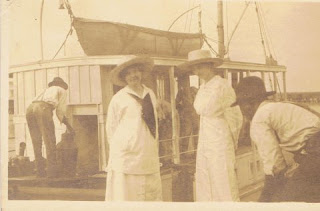
The back is the typical postcard back, with one half devoted to the message and one half to the address and the stamp.
Postcards serve not only as mementoes of travels, people, and places for the collector, but also serve the collector's ancestors as a means of placing the ancestor in his or her social context, a means of learning where the ancestor may have traveled, and even a way to see the important people in the ancestor's life.
Don't throw away those old postcards.
One way to do that is with postcards. My husband is fortunate in that his grandfather, Andrew Lewis Rhodes (1882-1966) collected postcards. His collection dates from the 1920s into the 1960s. The locations range from Florida, where he lived from young manhood until his death, to other southern states such as North Carolina, where the family vacationed.
Here is an example from his collection:

This is Jacksonville, Florida, circa 1925, showing the beach, Jacksonville Naval Air Station, a couple of city parks, and Oriental Gardens, a former tourist attraction which is now a subdivision. Andrew Lewis Rhodes lived in Jacksonville from the early 1920s until his death.

The postcard above shows the Hotel Regal in Tampa, where Andrew lived circa 1918-1920.
In the early 20th century, one could have a personal photograph made into a postcard. The example below is a photo of Andrew's wife Della Mae Marshall, facing the camera, circa 1918.

The back is the typical postcard back, with one half devoted to the message and one half to the address and the stamp.
Postcards serve not only as mementoes of travels, people, and places for the collector, but also serve the collector's ancestors as a means of placing the ancestor in his or her social context, a means of learning where the ancestor may have traveled, and even a way to see the important people in the ancestor's life.
Don't throw away those old postcards.
Subscribe to:
Posts (Atom)